
Harnessing AI for Data Analysis: Transforming Raw Numbers into Strategic Insights
AI for data analysis transforms raw numbers into strategic insights—identifying patterns, predicting trends, and optimizing decisions to drive impactful results.
9/17/20253 min read
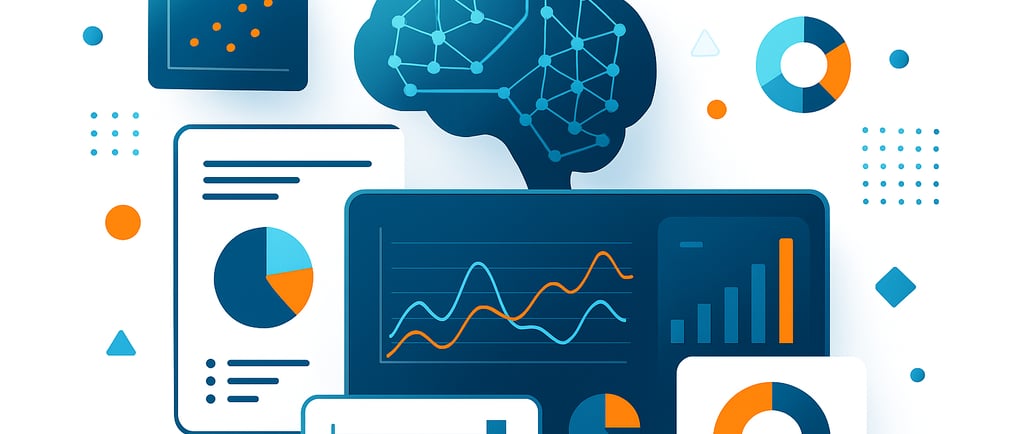
We live in an era where information is the most valuable asset of any organization. However, having access to large volumes of data (Big Data) is no longer, in itself, a competitive advantage. The true differentiator lies in the ability to process, interpret, and act on this data in real-time. This is where the transformative fusion between Data Analytics and Artificial Intelligence (AI) takes place.
This convergence is not just changing how companies operate; it is redefining the very nature of decision-making. From predicting consumer behavior to advanced medical diagnostics, the symbiosis between data and intelligent algorithms is the engine of the modern digital economy. This article explores how these technologies work, their tangible benefits, ethical challenges, and what the future holds for those who master data science.
The Evolution: From Static Data to Predictive Insights
To understand the impact of AI, it is fundamental to first understand the evolution of data analysis itself. Traditionally, business analysis looked in the rearview mirror. Today, with the support of advanced algorithms, we look at the horizon. We can classify this evolution into four crucial stages:
Descriptive Analytics: Answers the question "What happened?". It uses historical data to generate reports and KPIs regarding sales, traffic, or production.
Diagnostic Analytics: Focuses on "Why did it happen?". Here, Business Intelligence (BI) tools allow digging deeper into the causes of a drop in revenue or a spike in complaints.
Predictive Analytics: This is where AI begins to shine. Using statistical models and Machine Learning, it answers "What is likely to happen?". It predicts trends, churn risks, and market fluctuations.
Prescriptive Analytics: The most advanced stage. It answers "What should we do?". It not only predicts the future but also suggests optimal decisions—such as dynamically adjusting prices or automatically reordering stock—to maximize results.
AI is the catalyst that allows companies to leap from simple description to prescription, automating complex reasoning at a scale impossible for the human brain.
The Engine of Change: Machine Learning and Deep Learning
When we speak of AI in data analytics, we mostly refer to a subfield called Machine Learning. Unlike traditional software, which follows strict human-programmed rules (if X, then Y), Machine Learning models learn the rules themselves by analyzing vast datasets to find hidden patterns.
Within this field, Deep Learning stands out. Inspired by the neural structure of the human brain, Deep Learning uses neural networks with multiple layers to process unstructured data. This technology allows computers to "see" (Computer Vision) and "read" (Natural Language Processing), transforming images, videos, and texts into quantifiable and actionable data.
Strategic Impact: How AI Transforms Business
The practical application of these technologies generates a measurable Return on Investment (ROI) through three main vectors: speed, accuracy, and personalization.
Hyper-Personalization and Customer Experience In retail and digital marketing, the era of generic segmentation is over. Recommendation algorithms analyze millions of behavioral data points to suggest the exact product at the right time. AI analyzes customer sentiment through social media, allowing brands to adjust their communication strategies almost instantly.
Operational Efficiency and Automation Robotic Process Automation (RPA) combined with AI eliminates repetitive tasks. In banking, intelligent systems analyze loan applications in seconds. In industry, predictive maintenance uses IoT sensors to predict machine failure before it happens, saving millions in unplanned downtime.
Fraud Detection and Cybersecurity In a digital world, security is critical. AI excels at anomaly detection. By learning the "normal" pattern of network transactions, it can identify subtle deviations indicating fraud or intrusion, blocking the threat in milliseconds.
Challenges in Implementation: Data Quality
Despite the potential, AI and Big Data projects often fail. The main reason is rarely the technology, but the data. In data science, the maxim prevails: "Garbage in, Garbage out."
For an AI algorithm to be effective, it needs clean, organized, and representative data. Companies must invest in robust Data Architecture, such as Data Lakes or Cloud Data Warehouses, and implement strict Data Governance policies. Without ensuring information integrity, AI is merely a sophisticated tool making wrong decisions with high confidence.
Ethics, Privacy, and the Human Factor
As we delegate more decisions to algorithms, ethics becomes central. How do we ensure a hiring algorithm doesn't discriminate if it learned from biased historical data? Furthermore, data privacy is a critical legal concern (e.g., GDPR). Organizations must adopt Privacy by Design practices.
It is also crucial to demystify the idea that AI will replace humans. The future of work lies in augmented intelligence, where AI handles massive processing, while humans focus on creativity, strategy, empathy, and ethical oversight.
Conclusion
The union between AI and Data Analytics is the new infrastructure of human knowledge. The question is not how much information we can store, but how much intelligence we can extract from it. If you are ready to take the next step, start by auditing the quality of your data—for they are the foundation upon which the future of your business will be built.
Innovation
Discover how AI transforms everyday life
Technology
Blog
suportevirtual@futurodigital.blog
© 2025. All rights reserved.
Other Pages